By the Kidville Upper West Side Team · Updated October 2026
SHORT ANSWER
A 2-year-old should be learning to talk in two- to four-word sentences, follow simple instructions, run and kick a ball, scribble and stack blocks, sort by shape and color, and begin make-believe play, according to the AAP. Counting to 10 is not on the list. The Kidville University 2s program on the Upper West Side builds these skills through play.
Two is the age when parents start comparing notes at the playground. One child is counting, another is speaking in paragraphs, a third is still mostly pointing, and every parent quietly wonders which one is “on track.” This guide answers that with the American Academy of Pediatrics (AAP) milestone lists for age 2, explains what the AAP says about language, thinking and social skills at this age, flags the signs that are worth a call to your pediatrician, gives 10 things to practice at home, and shows how the Kidville University 2s program on the Upper West Side turns those milestones into a two-hour school morning. Every Kidville detail was checked on Kidville’s own pages on October 29, 2026.
What should a 2-year-old be learning?
Words, movement, hand skills, early thinking and the first steps of playing with others, all through play rather than lessons. The AAP’s Developmental Milestones: 2 Year Olds lists what most children do between their second and third birthdays across five areas, and it opens with a reminder that “each child develops at his own particular pace,” so the list is “a general idea of the changes you can expect,” not a test to pass.
| Area | What the AAP lists for a 2-year-old | What it looks like at home |
|---|---|---|
| Language | Points to an object or picture when it is named, recognizes names of familiar people, objects and body parts, uses simple phrases by 18 to 24 months, uses two- to four-word sentences, follows simple instructions, repeats words overheard in conversation | “More juice,” “Daddy go work,” bringing you the book you asked for |
| Movement | Walks alone, pulls toys behind while walking, carries a large toy or several toys, begins to run, stands on tiptoe, kicks a ball, climbs onto and down from furniture, walks up and down stairs holding on | Hallway runs, couch climbing, kicking a ball back to you |
| Hand and finger skills | Scribbles spontaneously, turns over a container to pour out contents, builds a tower of four blocks or more, might use one hand more than the other | Crayon on paper, dumping the toy bin, block towers |
| Cognitive | Finds objects hidden under two or three covers, begins to sort by shapes and colors, begins make-believe play | Shape sorters, “where did the ball go?”, feeding a doll |
| Social and emotional | Imitates adults and older children, increasingly aware of self as separate from others, increasingly enthusiastic about the company of other children, demonstrates increasing independence, begins to show defiant behavior | Copying you sweep, “me do it,” a first “no” |
Source: HealthyChildren.org, “Developmental Milestones: 2 Year Olds” (American Academy of Pediatrics), verified October 29, 2026
This guide is general information, not medical advice. If you have questions about your own child’s development, your pediatrician is the right person to ask.
What words should a 2-year-old be saying?
Around fifty words or more at the start of the year, growing into sentences of four to six words by the end of it. The AAP’s Language Development: 2 Year Olds says a 2-year-old “not only understands most of what you say” but “speaks with a rapidly growing vocabulary of fifty or more words,” and over the year moves from two- or three-word sentences to ones “with four, five, or even six words,” begins using pronouns like I, you, me and we, and “understands the concept of mine.”
The same page is clear about comparisons: “there’s more variation in language development than in any other area.” Some children build words steadily, others “in an uneven manner,” and some are simply more talkative. The AAP adds that the more verbal child is not “necessarily smarter or more advanced,” because “the quiet child may know just as many words but be choosier about speaking them,” and that boys as a group start talking later than girls, a gap that evens out by school age. Its one practical instruction is to make reading part of the everyday routine, since a 2-year-old “can follow a story line and will understand and remember many ideas” from books.

Should a 2-year-old count to 10 or know colors and letters?
Not yet. The AAP’s 2-year-old milestones are about sorting, matching and the idea of “two,” not reciting numbers or letters. The milestone list says a 2-year-old “begins to sort by shapes and colors,” and the AAP’s Cognitive Development: Two-Year-Old page explains that learning becomes “more thoughtful” at this age: a child can “match similar shapes” in shape sorters and simple jigsaw puzzles, starts to “recognize the purpose of numbers in counting objects, especially the number two,” understands simple time concepts like “you can play after you finish eating,” and becomes interested in cause and effect, from wind-up toys to light switches.
| Parents often ask | What the AAP lists for age 2 | How to support it |
|---|---|---|
| Should my 2-year-old count to 10? | Recognizing the purpose of numbers in counting objects, especially the number two | Count real things: two shoes, two cups, two blocks |
| Should they know colors? | Begins to sort by shapes and colors | Sort laundry by color, name colors as you hand things over |
| Should they know letters? | Not on the 2-year-old list; letters appear in the 3 to 4 milestones as copying some capital letters | Read daily and let letters be shapes on a page for now |
| Should they do puzzles? | Matching similar shapes in shape sorters and simple jigsaw puzzles | Two- to four-piece puzzles with knobs |
| Should they pretend? | Begins make-believe play, then strings activities into a logical sequence, such as putting a doll to bed and covering it up | A doll, a cup and a blanket are enough |
Built on HealthyChildren.org, “Developmental Milestones: 2 Year Olds”, “Cognitive Development: Two-Year-Old” and “Developmental Milestones: 3 to 4 Year Olds” (American Academy of Pediatrics), verified October 29, 2026
On the question of what counts as “advanced,” the AAP’s own language is a useful check: the list is a general idea of what to expect, and in the area where parents compare most, language, the variation is wider than anywhere else. A child who counts early is not ahead on the AAP’s list, and a child who does not is not behind on it.
What should I be teaching my 2-year-old at home?
Play, with you in the room and a few simple objects, is the teaching. The AAP’s The Power of Play says that for 1- to 3-year-olds, “playful learning, where children take the lead and follow their own curiosity, should be the main focus,” and that blocks, empty containers, wooden spoons, shape sorters and puzzles are “some of the best ways to support a child’s creativity and grasp of how the world works.” It adds that “it is parents and caregivers’ presence and attention that enriches children, not fancy electronic gadgets,” suggests a parent-supervised playdate at this age, and encourages make-believe play and whole-body movement like walking, jumping and standing on one leg.
| Practice at home | Milestone it builds (AAP) | How to do it in an apartment |
|---|---|---|
| Read the same book every night | Follows a story line, remembers ideas from books, grows vocabulary | Let your toddler turn the pages and finish the familiar lines |
| Narrate and expand | Two- to four-word sentences, pronouns | They say “car go,” you say “yes, the red car is going fast” |
| Count two of everything | Purpose of numbers, especially the number two | Two socks, two crackers, two steps |
| Sort the laundry | Begins to sort by shapes and colors | Dark pile, light pile; socks in one basket |
| Fill, dump and stack | Tower of four blocks or more, pours out contents | Empty containers and blocks on the kitchen floor |
| Simple two-step errands | Follows simple instructions | “Get your shoes and bring them to me” |
| Pretend together | Begins make-believe play, then sequences | Feed the doll, then put her to bed |
| Big-body play | Begins to run, kicks a ball, stands on tiptoe | Hallway kick-backs and tiptoe walks; see our gross motor activities guide |
| Crayons and dough | Scribbles spontaneously, hand and finger skills | A fat crayon and taped-down paper; see our fine motor activities guide |
| Name feelings out loud | Developing empathy | “Emma is sad because you took her car” is the AAP’s own example |
Built on HealthyChildren.org, “Developmental Milestones: 2 Year Olds”, “Language Development: 2 Year Olds”, “Cognitive Development: Two-Year-Old”, “Social Development: 2 Year Olds” and “The Power of Play” (American Academy of Pediatrics), verified October 29, 2026
On the social side, the AAP’s Social Development: 2 Year Olds page sets realistic expectations: children this age “may refuse to share things that interest them” and often play side by side rather than together, and “all other children their age probably are acting the same way.” It says 2-year-olds are also “developing the ability to express true empathy,” which parents can help along by talking about how other people feel. For low-pressure ways to put that into practice, our guide on where a toddler can socialize with other kids covers playdates, classes and the playspace.
How does the Kidville University 2s program teach these skills?
With a two-hour school morning built around the exact things the AAP lists: language, hands, movement, thinking and playing alongside other children, plus a gradual separation from you. The KVU 2s page describes the program as a “social pre-school alternative program offering children a positive first school experience,” 120 minutes a day, 2 or 3 days a week, where “teachers serve as guides for parents and children during a gradual and individualized separation process.” The main Kidville University page adds a 1:4 teacher-to-child ratio, an emergent curriculum that “caters to the classroom’s interests in real time,” and a consistent daily routine.
| Part of the KVU 2s morning | What happens (from the Kidville page) | AAP milestones it works |
|---|---|---|
| Welcome time | An inviting environment, “think: digging bins,” welcomes kids as they say “see ya later” to grown-ups once separated | Independence, separation, hand skills |
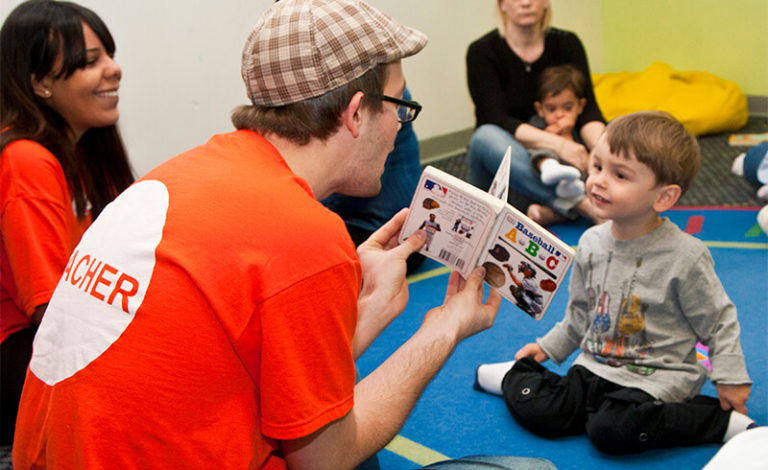
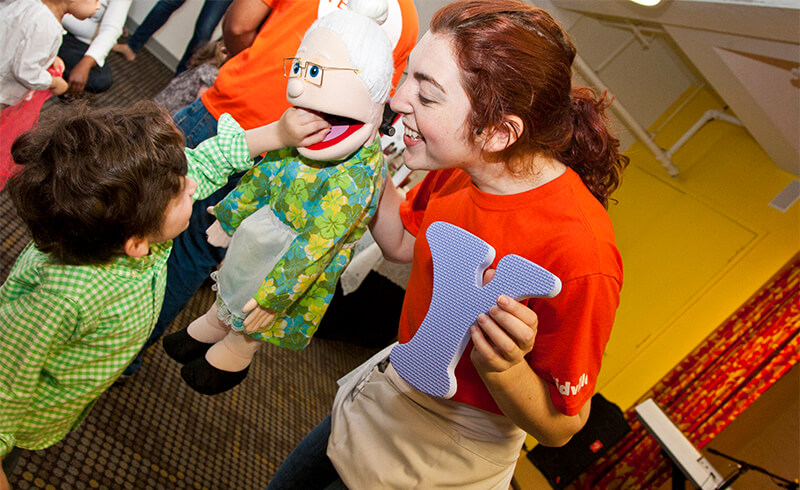
| Circle time | An interactive hello song, story time, music movement and dramatic play introduce the weekly theme | Follows a story line, repeats words, imitates others, make-believe |
| Art and STEM | Open-ended art and exploration with “a myriad of tactile materials” | Scribbles, sorting by shape and color, cause and effect |
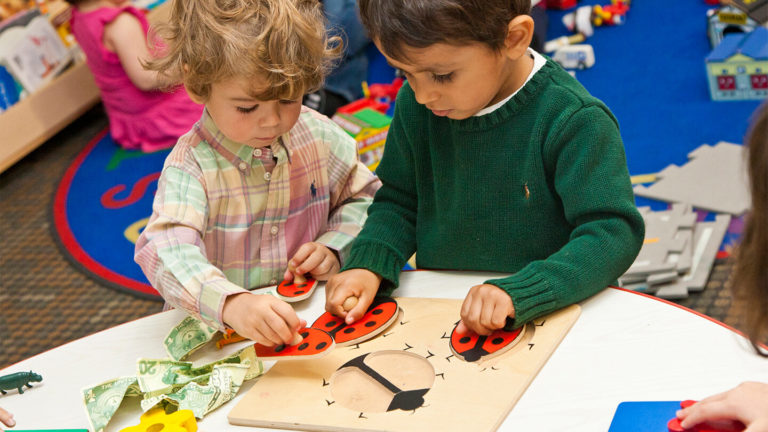
| Class centers | Children move freely between dramatic play, reading, puzzles and other manipulatives | Make-believe play, matching shapes in simple puzzles, choosing for themselves |
| Snack time | A light snack during community time for “socializing, practicing manners, and a little time to decompress” | Company of other children, simple instructions, independence |
| Gym | Time to “shake out their sillies” and burn off energy | Runs, climbs, kicks a ball |
Source: Kidville Upper West Side KVU 2s and Kidville University pages, verified October 29, 2026
Families who are not ready for a separation program have the same skills on offer in parent-and-child classes. The Kidville Upper West Side classes page lists gym from 6 months up (obstacle courses, giant blocks, Tumbl Trak, indoor swings), art from 18 months up (giant paper painting and hands-on projects), music from newborn up (original songs and familiar favorites with a live band), and STEM from 2 years up (weekly units built around scientific themes), with 45-minute classes through a membership (Single $219 a month for 4 classes, Double $399 a month for 8 classes) and a free trial class to start. Our kids classes by age guide walks through which ones fit a 2-year-old, and our preschool alternative guide has the KVU schedules, prices and enrollment details.

Possible downside: KVU 2s is a set-schedule program, two or three set mornings a week, with tuition paid in full at enrollment, so it suits families who want a consistent routine more than a drop-in. The gradual separation also asks for a parent or caregiver on hand in the early weeks. If you are still deciding whether a classroom is the right next step, our guide on how to prepare a toddler for preschool covers the readiness signs, and you can request a tour and watch a morning in progress.
What are red flags for a 2-year-old?
The AAP lists eight specific signs for this age range and says to alert your pediatrician if you see any of them. Its developmental health watch for 2-year-olds names: cannot walk by eighteen months; fails to develop a mature heel-toe walking pattern after several months of walking, or walks exclusively on the toes; does not speak at least fifteen words by eighteen months; does not use two-word sentences by age two; does not seem to know the function of common household objects (brush, telephone, bell, fork, spoon) by fifteen months; does not imitate actions or words by the end of this period; does not follow simple instructions by age two; cannot push a wheeled toy by age two.
| Usually normal at 2 | Worth a call to your pediatrician (AAP) |
|---|---|
| A quiet child who understands you but says less than a chatty peer | No two-word sentences by age two, or fewer than fifteen words at eighteen months |
| Playing beside other children rather than with them | Not imitating actions or words by the end of this period |
| Saying “no” and wanting to do things alone | Not following simple instructions by age two |
| Preferring one hand, or no preference yet | Not walking by eighteen months, or walking only on the toes |
| Not counting, not knowing letters | Not seeming to know what a brush, spoon or telephone is for by fifteen months |
Source: HealthyChildren.org, “Developmental Milestones: 2 Year Olds” developmental health watch (American Academy of Pediatrics), verified October 29, 2026
What should a 2-year-old be learning: FAQ
What should a 2 year old be taught?
Nothing that needs a worksheet. The AAP says the main focus for 1- to 3-year-olds should be playful learning where the child leads, with simple objects like blocks, containers, shape sorters and puzzles, daily reading, make-believe play, movement and a supervised playdate. The milestones that come from that play are two- to four-word sentences, following simple instructions, sorting by shape and color, scribbling, stacking, running and kicking a ball.
What skills should a 2 year old learn?
The AAP’s 2-year-old milestones fall into five groups: language (fifty or more words growing into four- to six-word sentences, simple instructions), movement (running, kicking a ball, climbing, stairs with support), hand skills (scribbling, towers of four blocks, pouring out a container), thinking (sorting by shape and color, hidden objects, make-believe) and social skills (imitating adults, enjoying other children, growing independence and the first defiance).
What is considered advanced for a 2 year old?
The AAP does not define “advanced” for this age, and it cautions against the comparison most parents make. Its language page says there is more variation in language development at 2 than in any other area, that a more verbal child is not necessarily smarter or more advanced, and that a quiet child may know just as many words. Early counting or letters are not milestones the AAP lists for age 2, so they are a bonus, not a benchmark.
Should a 2.5 year old count to 10?
Not according to the AAP milestones. For age 2 the AAP lists recognizing “the purpose of numbers in counting objects, especially the number two,” plus sorting by shapes and colors and matching shapes in simple puzzles. Reciting numbers to 10 is not a milestone the AAP lists at this age. Counting two real things, two shoes or two crackers, is the skill the AAP describes, and it is the one worth practicing.
What are red flags for a 2-year-old?
The AAP’s developmental health watch for this age lists: not walking by eighteen months, walking only on the toes, fewer than fifteen words at eighteen months, no two-word sentences by age two, not knowing what a spoon or brush is for by fifteen months, not imitating actions or words, not following simple instructions by age two, and not pushing a wheeled toy by age two. Any of these is a reason to alert your pediatrician.
What do 2 year olds learn in preschool?
In a 2s program like Kidville University on the Upper West Side, the morning is built from the same skills the AAP lists: circle time with a hello song, a story, music and movement and dramatic play around a weekly theme; open-ended art and STEM exploration; class centers for dramatic play, reading, puzzles and manipulatives; snack time for socializing and manners; and gym. Underneath all of it is a gradual, teacher-guided separation from the parent, with a 1:4 teacher ratio.
The bottom line
A 2-year-old should be learning to talk in short sentences, follow simple instructions, run and climb, scribble and stack, sort by shape and color, pretend, and start enjoying other children, all through play with you nearby. Counting to 10 and letters can wait, and the AAP’s red-flag list is short and specific. On the Upper West Side, the Kidville University 2s program turns those milestones into a two-hour school morning with a gradual separation, a 1:4 ratio and a routine your toddler can count on.
Curious what a 2s morning looks like? See the KVU 2s program at Kidville Upper West Side, 205 West 88th Street, New York, NY 10024, and request a tour. Call 212-362-7792 with questions.
ABOUT THE AUTHOR
The Kidville Upper West Side Team runs the Kidville location at 205 West 88th Street, New York, NY 10024, home to music, gym, art, dance and STEM classes, Kidville University, Camp Kidville, an indoor playspace, birthday parties and a kids salon for children from birth to age 6. Every age, price and schedule detail in our guides is checked against Kidville’s own published pages.
Sources
Every Kidville program detail in this guide comes from Kidville Upper West Side’s own pages, checked on October 29, 2026. Developmental milestones and guidance come from HealthyChildren.org, the American Academy of Pediatrics’ parenting site.
Kidville Upper West Side: KVU 2s Program (Enrollment and Daily Schedule)
Kidville Upper West Side: Kidville University (Preschool Alternative)
Kidville Upper West Side: Classes and Programs
Kidville Upper West Side: Membership
Kidville Upper West Side: Contact
HealthyChildren.org (American Academy of Pediatrics): Developmental Milestones: 2 Year Olds
HealthyChildren.org (American Academy of Pediatrics): Language Development: 2 Year Olds
HealthyChildren.org (American Academy of Pediatrics): Cognitive Development: Two-Year-Old
HealthyChildren.org (American Academy of Pediatrics): Social Development: 2 Year Olds