

Gross Motor Activities for Toddlers: Ideas by Age and Where to Practice on the Upper West Side
By the Kidville Upper West Side Team · Updated October 2026
SHORT ANSWER
Gross motor activities for toddlers are games that work the big muscles: crawling through tunnels, climbing, running, jumping, kicking and throwing. The AAP lists walking alone, starting to run, kicking a ball and climbing onto furniture as 2-year-old milestones. On the Upper West Side, Kidville’s gym classes and indoor playspace are built around these skills.
Toddlers do not need to be taught to move. They need room, a safe place to fall and something worth climbing. Gross motor play is how they get stronger, steadier and braver, and in a New York apartment it takes a little planning. This guide explains what gross motor skills are, the movement milestones the American Academy of Pediatrics lists at 1, 2 and 3, indoor activities that fit a living room, and how the Kidville Upper West Side gym classes turn the same skills into a weekly routine. Every Kidville detail was checked on Kidville’s own pages on October 22, 2026.
What are gross motor skills, and why do they matter for toddlers?
Gross motor skills use the large muscles of the arms, legs and trunk: crawling, walking, running, jumping, climbing, kicking and throwing. Fine motor skills are the small hand movements, like picking up a crumb or holding a crayon; our fine motor activities for toddlers guide covers those. The AAP’s guide How Active Is Your Toddler? describes the goal of toddler play as practicing physical skills like walking, running, squatting and climbing, and notes that just 15 minutes a day of quality one-on-one time helps with physical development. Its article on movement milestones in preschoolers adds that movement also helps children understand new words and ideas.
| Gross motor skill | What it builds | Everyday example |
|---|---|---|
| Crawling | Arm and shoulder strength, coordination of both sides of the body | Crawling through a tunnel or under a table |
| Walking and running | Balance, leg strength, speed control | Chasing bubbles across the room |
| Climbing | Strength, planning, courage | Climbing onto the couch and back down |
| Jumping | Leg power, landing safely | Jumping off the bottom step onto a cushion |
| Kicking and throwing | Aim, timing, balance on one leg | Kicking a soft ball to a parent |
Built on HealthyChildren.org, “How Active Is Your Toddler?” and “Movement Milestones in Preschoolers” (American Academy of Pediatrics), verified October 22, 2026
This guide is general information, not medical advice. If you have questions about how your child moves, walks or balances, your pediatrician is the right person to ask.
What gross motor skills should a toddler have at 1, 2 and 3?
Around 1, toddlers pull up and cruise; around 2, they walk alone, start to run and climb furniture; around 3, they ride a tricycle and throw overhand. These come from the AAP’s milestone pages for 12 months, 2 year olds and 3 to 4 year olds. Every child moves at their own pace, so use the table as a guide to what to practice, not as a test.
| Age | Movement milestones the AAP lists | Activities that practice them |
|---|---|---|
| Around 12 months | Pulls self up to stand; walks holding on to furniture; stands momentarily without support; may walk two or three steps | Cruising along the couch to reach a toy, pushing a sturdy box, crawling through a tunnel |
| 2 years | Walks alone; pulls toys while walking; begins to run; stands on tiptoe; kicks a ball; climbs onto and down from furniture; walks up and down stairs holding on | Pull toys, chasing games, kicking a soft ball, a cushion climb, stairs with a hand to hold |
| 3 to 4 years | Hops and stands on one foot up to 5 seconds; kicks a ball forward; throws a ball overhand; pedals a tricycle; climbs on and off a couch or chair | Hopscotch with tape on the floor, catch with a big ball, tricycle in the park, freeze dance |
Source: HealthyChildren.org, “Developmental Milestones: 12 Months”, “Developmental Milestones: 2 Year Olds” and “Developmental Milestones: 3 to 4 Year Olds” (American Academy of Pediatrics), verified October 22, 2026
The AAP’s preschool movement article also notes that at 3, a child may still need to make a conscious effort to stand on tiptoes or one foot, get up from a squat or catch a ball, which is exactly why repetition in play matters. For the baby stage, our baby gym classes guide covers 8 to 15 months in detail.
What are some fun gross motor activities for toddlers indoors?
The best indoor gross motor activities need a cleared floor, a few cushions and a grown-up who plays too. The AAP suggests child-led walks, dance parties and bubble play for toddlers, and for older toddlers crab-walk races, Floor is Lava and Red Light, Green Light. All of them fit in a living room and none need special equipment.
| Indoor activity | What you need | Skills it works | Good from |
|---|---|---|---|
| Bubble chase | A bubble wand | Walking, running, reaching, stopping | Walking toddlers |
| Dance party | A playlist | Balance, rhythm, jumping | 1 year |
| Cushion mountain | Couch cushions on the floor | Climbing up and safely down | 1 year, with a grown-up close |
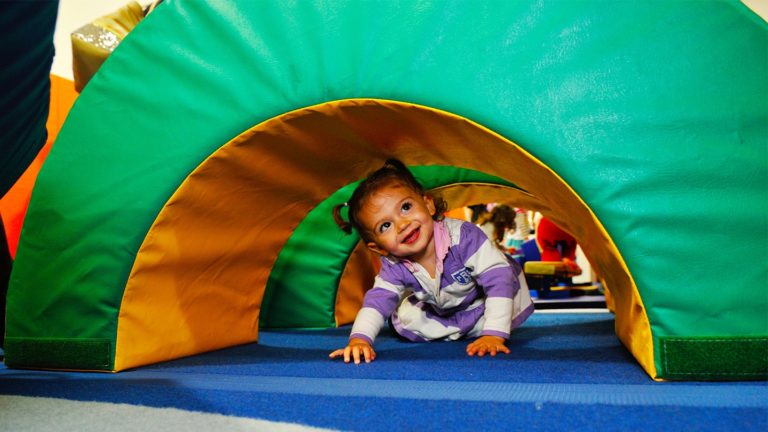
| Tunnel crawl | A play tunnel or a blanket over two chairs | Crawling, shoulder strength | 1 year |
| Floor is Lava | Pillows or tape spots on the floor | Jumping, balance, planning a path | 2 years |
| Crab-walk races | Open floor | Arm and core strength | 2 to 3 years |
| Red Light, Green Light | A hallway | Running, stopping, listening | 2 to 3 years |
Ideas from HealthyChildren.org, “How Active Is Your Toddler?” (American Academy of Pediatrics), verified October 22, 2026; ages are starting points, and your own child and your supervision set the pace
The AAP also recommends putting your phone away and setting a timer for play, and staying close so you can step in if a toddler heads for something they should not. Many of these games double as sensory play; our sensory play for toddlers guide has more ideas that mix the two.
Where can toddlers practice gross motor skills on the Upper West Side?
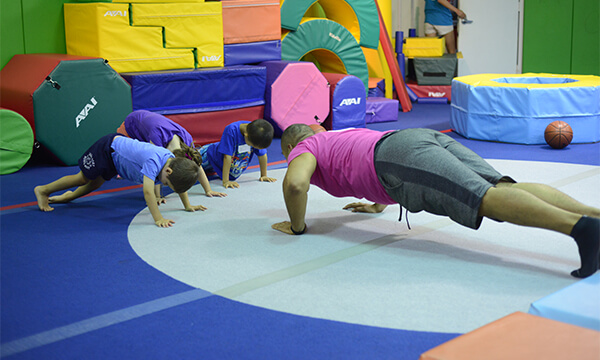
In a Kidville gym class, where coaches rotate equipment every week, or in the indoor playspace on days without class. The Kidville gym classes page describes a familiar routine that moves from warm-ups to exploration, skill sharing and cool down, anchored by a theme, in a gym space with a weekly rotation of equipment, obstacle courses and props. Kidville lists the developmental benefits as strength and flexibility, from forward rolls to toe touches; courage and confidence through safe risk-taking with a supportive coach; active play, from the Tumbl Trak to the swings; and social skills such as teamwork and turn-taking.

| Kidville option | Ages | What toddlers do | Cost |
|---|---|---|---|
| Big Muscles for Little Babies | 8 to 15 months | Inclines, balls, tunnels and the Tumbl Trak while moving from sitting to standing and crawling to cruising; indoor swings and bubble dances | Membership: $219 a month for 4 classes or $399 for 8 |
| Big Muscle Builders | 12 to 24 and 18 to 36 months | Climbing courses, jumping on the Tumbl Trak, indoor swings, and lifting, carrying and stacking giant blocks | Membership: $219 a month for 4 classes or $399 for 8 |
| Indoor playspace | Toddlers with a grown-up | Open play in the Kidville gym | $31 per 1-hour session; packs of 5 for $150 or 10 for $290; register in advance |
| Free trial class | Any class on the schedule | One gym class to see if it fits | Free; playspace does not count as the trial |
Source: Kidville Upper West Side gym classes, playspace, membership and trial class pages, verified October 22, 2026
Kidville describes Big Muscle Builders as preparing children for gymnastics and sports. For what a class looks like week to week, see our toddler gym classes guide, and for choosing between a class and open play on a cold or wet day, our indoor gym classes guide and rainy day activities guide.
Possible downside: class spots are limited and your child is enrolled in the same class each week, so a gym class takes a weekly commitment. Grayed-out enrollment buttons mean a class is full or outside its enrollment window, and the front desk can add you to a waitlist at 212-362-7792. Playspace sessions must be booked in advance, and weekend hours depend on the birthday party schedule.
How can parents help a toddler build gross motor skills safely?
Give them space, let them lead, and stay close without hovering. The AAP’s preschool movement article says a few bumps and bruises are a normal part of learning to move and that you do not need to hover over solo play at home, but that your attention matters most around other children, hazardous equipment and traffic, and that the same close watching matters any time your child is near water.
| Do | Why | AAP source |
|---|---|---|
| Let your toddler lead the walk or the game | Child-led play keeps them interested longer | How Active Is Your Toddler? |
| Put the phone away and set a timer | 15 minutes of focused one-on-one time helps physical development | How Active Is Your Toddler? |
| Stay close around equipment and other kids | Self-control and coordination are still developing | Movement Milestones in Preschoolers |
| Watch closely any time they are near water | Never leave a child alone in a pool or at the beach, even if they can swim | Movement Milestones in Preschoolers |
| Repeat favorite games | Skills like standing on one foot and catching still take effort at 3 | Movement Milestones in Preschoolers |
Source: HealthyChildren.org, “How Active Is Your Toddler?” and “Movement Milestones in Preschoolers” (American Academy of Pediatrics), verified October 22, 2026
Gross motor activities for toddlers: FAQ
What are 5 examples of gross motor skills?
Crawling, walking, running, jumping and climbing are five classic examples, and kicking and throwing a ball are close behind. Each one uses the large muscles of the legs, arms and trunk. The AAP lists walking alone, beginning to run, kicking a ball and climbing onto and down from furniture among its 2-year-old milestones. Kidville’s toddler gym class practices all of them on climbing courses, the Tumbl Trak and giant blocks.
What are some fun gross motor activities for toddlers indoors?
Bubble chases, dance parties, a cushion mountain, a tunnel crawl, Floor is Lava, crab-walk races and Red Light, Green Light all work in an apartment. The AAP suggests dance parties and bubble play for toddlers, plus crab-walk races and Floor is Lava for older toddlers. Clear the floor, move anything sharp, and play along. For bigger equipment, Kidville’s indoor playspace runs one-hour sessions for $31.
What gross motor skills should a 1 year old have?
Around 12 months, the AAP lists getting to sitting without help, crawling, pulling up to stand, walking while holding on to furniture, standing for a moment without support, and maybe taking two or three steps alone. Every baby gets there on their own schedule. Cruising along a couch and crawling through tunnels are great practice, and Kidville’s Big Muscles for Little Babies class covers 8 to 15 months.
What are some good gross motor activities for a 2-year-old?
Good choices include chasing bubbles, kicking a soft ball, climbing a cushion pile, pulling a toy on a string, jumping to music and simple running games. The AAP says 2-year-olds begin to run, stand on tiptoe, kick a ball and climb onto and down from furniture, so games that use those moves fit well. Kidville’s Big Muscle Builders class for 18 to 36 months adds climbing courses, swings and the Tumbl Trak.
What gross motor skills should a 3 year old have?
By 3 to 4, the AAP lists hopping and standing on one foot for up to five seconds, kicking a ball forward, throwing a ball overhand, catching a bounced ball most of the time and pedaling a tricycle. Its preschool movement article adds that a 3-year-old walks steadily and can ride a tricycle with ease, while standing on one foot and catching still take effort. Hopscotch, catch and obstacle courses are good practice.
How do I improve my child’s gross motor skills?
Make time every day for active play, let your child lead, and repeat the games they love. The AAP notes that just 15 minutes a day of focused one-on-one time helps physical development. Offer things to climb, push, kick and throw, stay close around equipment and water, and add a weekly class if you can. Kidville’s gym classes rotate equipment weekly, and your first class is free.
The bottom line
Gross motor activities for toddlers are simple: room to move, a few cushions and a grown-up who plays along. The AAP’s milestones give you a guide to what to practice at 1, 2 and 3, and its everyday ideas, from dance parties to Floor is Lava, fit in any apartment. On the Upper West Side, Kidville’s Big Muscles for Little Babies and Big Muscle Builders classes add climbing courses, the Tumbl Trak and indoor swings, with the playspace for the days in between.
Ready to get moving? See the Kidville gym classes at Kidville Upper West Side, 205 West 88th Street, New York, NY 10024, or claim a free trial class. Call 212-362-7792 with questions.
ABOUT THE AUTHOR
The Kidville Upper West Side Team runs the Kidville location at 205 West 88th Street, New York, NY 10024, home to music, gym, art, dance and STEM classes, Kidville University, Camp Kidville, an indoor playspace, birthday parties and a kids salon for children from birth to age 6. Every age, price and schedule detail in our guides is checked against Kidville’s own published pages.
Sources
Every Kidville class, age and price detail in this guide comes from Kidville Upper West Side’s own pages, checked on October 22, 2026. Milestone, play and safety guidance comes from HealthyChildren.org, the American Academy of Pediatrics’ parenting site.
Kidville Upper West Side: Gym Classes
Kidville Upper West Side: Playspace and Holiday Schedule
Kidville Upper West Side: Free Trial Class
Kidville Upper West Side: Enrollment Options and Membership
Kidville Upper West Side: Contact
HealthyChildren.org (American Academy of Pediatrics): How Active Is Your Toddler?
HealthyChildren.org (American Academy of Pediatrics): Movement Milestones in Preschoolers
HealthyChildren.org (American Academy of Pediatrics): Developmental Milestones: 12 Months
HealthyChildren.org (American Academy of Pediatrics): Developmental Milestones: 2 Year Olds
HealthyChildren.org (American Academy of Pediatrics): Developmental Milestones: 3 to 4 Year Olds