

By the Kidville Upper West Side Team · Updated October 2026
SHORT ANSWER
Fine motor activities for toddlers are small-hand tasks like stacking blocks, scribbling, pouring, peeling stickers and squeezing dough. The AAP lists towers of four blocks and scribbling by age 2, and child-safe scissors and drawing circles by 3 to 4. My Big Messy Art Class on the Upper West Side adds a new art instrument every week.
Gross motor skills get the attention because they are easy to see: a toddler who runs and climbs looks busy. The quieter work is happening in the hands. Picking up a pea, turning a page, holding a crayon and unzipping a jacket all depend on fine motor skills, the small movements of the wrist, hand and fingers, and those skills are built through play, not practice sheets. This guide explains what fine motor skills are, what the American Academy of Pediatrics (AAP) says a 1, 2 and 3-year-old can do, 12 easy activities you can run in an apartment, how to fit them into a week, and how My Big Messy Art Class at Kidville Upper West Side is built to work those little fingers. Every Kidville detail was checked on Kidville’s own pages on October 28, 2026.
What are fine motor skills?
Fine motor skills are the small, precise movements of the hands and fingers, usually working together with the eyes. The AAP’s guide Hand and Finger Skills: 1 Year Olds describes them as the “more subtle changes” in a child’s “ability to use her hands, both alone and in coordination with her eyes,” which give “much more control and precision” and “greatly expand her ability to explore and learn about the world.” Gross motor skills, by contrast, use the big muscles for walking, running and climbing; our gross motor activities for toddlers guide covers those.
| Fine motor skill | What it looks like in a toddler | Where the AAP places it |
|---|---|---|
| Pincer grasp | Picking up a small piece of food between thumb and index finger | Uses pincer grasp by 12 months |
| Releasing on purpose | Dropping blocks into a bucket, then dumping them out | Puts objects into a container and lets objects go voluntarily by 12 months |
| Stacking and building | Towers of blocks that get taller each month | Tower of four blocks or more by age 2; six blocks high at age 2 (hand and finger guide) |
| Scribbling and drawing | Sweeping lines, then circles, then a person | Scribbles spontaneously by age 2; draws circles and squares by 3 to 4 |
| Everyday hand tasks | Turning pages, pulling off shoes, unzipping a large zipper, unscrewing a jar lid | Described for 2-year-olds in the AAP hand and finger guide |
Built on HealthyChildren.org, “Developmental Milestones: 12 Months”, “Developmental Milestones: 2 Year Olds”, “Developmental Milestones: 3 to 4 Year Olds” and “Hand and Finger Skills: 2 Year Olds” (American Academy of Pediatrics), verified October 28, 2026
This guide is general information, not medical advice. If you are worried about how your child uses their hands, your pediatrician is the right person to ask.
What fine motor skills should a 1, 2 and 3-year-old have?
Each year adds precision: grasping at 1, stacking and scribbling at 2, cutting and copying shapes at 3 to 4. The AAP’s milestone lists give parents a realistic picture of what hands can do at each age, and its Hand and Finger Skills: 1 Year Olds guide notes that picking up very small objects between thumb and forefinger is “still a challenge” at twelve months but “will be simple” by the middle of the second year. The same guide says many children do not show a clear hand preference for several years and there is “no reason to pressure your toddler to use one hand over the other.”

| Age | Hand and finger skills the AAP lists | What that means for play |
|---|---|---|
| 12 months | Uses pincer grasp, bangs two cubes together, puts objects into and takes them out of a container, lets objects go voluntarily, pokes with index finger, tries to imitate scribbling | Fill-and-dump games, big chunky blocks, a fat crayon to copy your scribble |
| 1 to 2 years | Building towers of up to four blocks, covering and uncovering containers, turning knobs and pages, putting round pegs into holes, scribbling and painting; nearing 2, stacking five or six blocks, folding paper if shown, making shapes from clay | Board books, shape sorters with round pegs first, dough and finger paint |
| Age 2 | Scribbles spontaneously, turns over a container to pour out contents, builds a tower of four blocks or more; the hand and finger guide adds turning pages, pulling off shoes, unzipping a large zipper, unscrewing a jar lid, using a cup with one hand | Pouring at the sink or bath, dressing practice, crayons and fingerpaints, interlocking construction sets |
| 3 to 4 years | Copies square shapes, draws a person with head and one other body part, uses child-safe scissors, draws circles and squares, begins to copy some capital letters | Cutting practice with child-safe scissors, tracing shapes, first letters of their name |
Source: HealthyChildren.org, “Developmental Milestones: 12 Months”, “Hand and Finger Skills: 1 Year Olds”, “Developmental Milestones: 2 Year Olds”, “Hand and Finger Skills: 2 Year Olds” and “Developmental Milestones: 3 to 4 Year Olds” (American Academy of Pediatrics), verified October 28, 2026
The AAP’s 2-year-old hand and finger guide describes the first crayon grip in detail: thumb on one side, fingers on the other, “clumsy as this grip may seem,” it gives “enough control to create his first artistic masterpieces, using sweeping vertical and circular strokes.” In other words, scribbles are a milestone, not a mess.
What are some easy fine motor activities for toddlers at home?
Twelve activities that need nothing more than what is already in an Upper West Side kitchen, most of them 5 to 10 minutes long. Several come straight from the games the AAP says 1-year-olds love: building and knocking down towers, covering and uncovering containers, turning knobs and pages, putting pegs into holes, and scribbling and painting. The AAP adds that these games also teach spatial concepts “such as in, on, under, and around.”
| Activity | Best age | Skill it works | How to set it up |
|---|---|---|---|
| Fill and dump | 12 months+ | Grasp and release | A bowl and six large blocks or wooden spoons; in, out, repeat |
| Tower and crash | 12 months+ | Stacking, hand-eye coordination | Soft or wooden blocks; your toddler stacks, you count, they knock it down |
| Page turning | 12 months+ | Finger isolation | Board books; let your toddler turn every page, even out of order |
| Fat crayon scribbles | 12 months+ | Grip, wrist movement | Tape a big sheet of paper to the floor so the paper stays put |
| Peg and hole | 15 months+ | Precision, matching | Shape sorter with round pegs first; square pegs are harder, the AAP notes, because they involve matching angles |
| Sticker peel | 18 months+ | Pincer grasp | Large stickers half-lifted for them; move to full peel when ready |
| Dough squeeze and shape | 18 months+ | Hand strength | Play dough or homemade dough; squeeze, roll, poke, make shapes |
| Pour and scoop | 2 years+ | Wrist control, bilateral use | Two cups and dry rice or water in the bath; pouring and dumping both count |
| Zip, unzip, shoes off | 2 years+ | Everyday hand tasks | A jacket with a large zipper and slip-on shoes at the door; let it take a minute |
| Jar lids | 2 years+ | Wrist rotation | Clean, empty jars with wide lids; unscrew, screw, hide a toy inside |
| Tear and glue collage | 2 years+ | Bilateral coordination | Old magazines torn into strips, a glue stick and one sheet of paper |
| Child-safe scissors | 3 years+ | Cutting, hand strength | Snip fringe along the edge of a strip of paper before trying to cut across it |
Activities built on the hand and finger milestones at HealthyChildren.org (American Academy of Pediatrics), verified October 28, 2026; age guides are starting points, not deadlines
Many of these overlap with sensory play, and the messier versions work even better for busy fingers: our sensory play for toddlers guide has bin ideas by age, and our guide on what to do with a toddler during the week shows where a 10-minute hand activity fits in a weekday routine.
How do I improve my toddler’s fine motor skills?
Short, daily, playful practice beats long sessions, and the best activities are the ones your toddler would choose anyway. The AAP’s guidance on hands is built around play: towers to knock down, boxes to open, pages to turn, crayons and fingerpaints to “let him loose” with. There is no drill to run. What helps is opportunity, variety and patience, plus a few habits that keep the practice from becoming a battle.
| Habit | Why it works | What the AAP says |
|---|---|---|
| Let slow things be slow | Zipping a jacket or pulling off shoes is fine motor practice, so build in the extra minute | The AAP lists pulling off shoes and unzipping a large zipper among 2-year-old hand skills |
| Change the tool, keep the task | A crayon, a chalk stick, a paint roller and a sponge each ask the hand to grip differently | The AAP describes the first crayon grip as clumsy but good enough for real strokes |
| Offer both hands | Hand preference can take years; do not push one hand | No reason to pressure your toddler to use one hand over the other |
| Pair hands with words | Name what the hand is doing: in, on, under, around | Hand games teach spatial concepts such as in, on, under and around |
| Stop before frustration | Five good minutes beats twenty tearful ones | Attention span is longer at 2 than at 18 months, so sessions can grow with age |
Built on HealthyChildren.org, “Hand and Finger Skills: 1 Year Olds” and “Hand and Finger Skills: 2 Year Olds” (American Academy of Pediatrics), verified October 28, 2026
How does My Big Messy Art Class build fine motor skills?
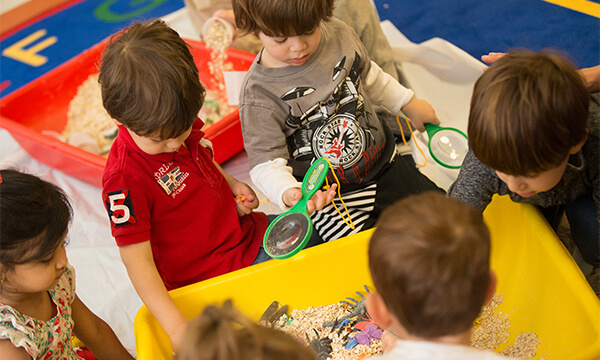
By handing toddlers a new art instrument every week, from jumbo crayons to paint rollers, in a studio built for small hands and big messes. The Kidville Upper West Side Art Classes page lists fine motor skills as one of the series’ developmental benefits: “From jumbo crayons to paint rollers! Your little one’s wrist, hand and fingers will be engaged through our introduction of new art instruments each week.” The studio is “designed for hands-on fun with toddler-sized tools, smocks, and a wall outfitted for painting,” the approach is “process over product,” and Kidville handles the clean up.
| What happens in class | Fine motor skill it works | From the Kidville page |
|---|---|---|
| A new art instrument each week | Different grips: crayon, roller, brush, sponge, chalk | “Jumbo crayons to paint rollers”; wrist, hand and fingers engaged |
| Sensory play bins | Scooping, pinching, pouring | “Sensory play bins, writing tables, and giant paper painting” |
| Paints, doughs, crayons, chalk and collage | Squeezing, squishing, tearing, sticking | A “variety of materials” after storybook sharing |
| Giant paper and a painting wall | Big arm strokes that lead to controlled hand strokes | A wall “outfitted for painting”; fun “too big to try at home” |
| Process over product | Freedom to repeat the movement that is being mastered | “No expectations other than discovery”; “we never touch the art” |
Source: Kidville Upper West Side Art Classes page, verified October 28, 2026
My Big Messy Art Class runs for 18 to 36 months and 2 to 4 years, so a toddler who is just starting to scribble and a 3-year-old practicing scissors can each find a group. Classes are 45 minutes and come through a membership (Single $219 a month for 4 classes plus 3 playspace passes, Double $399 a month for 8 classes plus unlimited playspace), and a free trial class lets you watch your toddler with the tools before you commit. For a full walk-through of the class, see our art classes for toddlers guide, and the Art Classes page adds that the same sessions build language (color, shape and texture words), problem solving (which color first, where to place the brush) and confidence.
Possible downside: the art studio is a once-a-week, 45-minute dose. Fine motor skills grow from daily use, so the class works best as the messy anchor of a week that also includes the small at-home tasks above. A class that stays full shows a grayed-out enroll button on the schedule, so call or contact Kidville about the waitlist if your preferred time is taken.
Which fine motor activities are safe for toddlers?
The small objects that build the pincer grasp are also the ones the AAP lists as choking hazards, so match the object to the age and supervise closely. The AAP’s choking prevention guide names toys with small parts, toys that can be squeezed to fit entirely into a child’s mouth, small balls, pen or marker caps, and small button-type or lithium coin batteries among dangerous household items. For toddlers under 3, that means large blocks over small beads, big stickers over tiny ones, and dough play with you sitting right there.
| Safer choice | Save for later | Why |
|---|---|---|
| Large wooden blocks, chunky pegs | Small beads, buttons, loose marbles | The AAP lists small balls and small toy parts as choking hazards |
| Jumbo crayons, markers with caps kept by you | Loose pen or marker caps | Pen or marker caps are on the AAP list |
| Play dough in a supervised session | Dough or clay left out with a child alone | Dough can be bitten off; stay within reach |
| Board books, large sticker sheets | Small sticker sheets, paper clips | Small items that can be squeezed into the mouth are the risk |
| A gym playspace for climbing and ball play | Toy bins with mixed small parts | Kidville’s playspace is a 1-hour, $31 session in a converted gym; grownups wear socks and stay within hug’s reach |
Built on HealthyChildren.org, “Choking Prevention for Babies and Children” (American Academy of Pediatrics) and the Kidville Upper West Side Playspace page, verified October 28, 2026
When the hands are ready for a bigger room, the Kidville playspace is a converted gym where kids can run, climb and make new friends, which pairs well with a week of small-hand practice at home.
Fine motor activities for toddlers: FAQ
What are 5 examples of fine motor skills?
Five examples from the AAP’s milestone lists are the pincer grasp (picking up small food between thumb and index finger by 12 months), putting objects into and out of a container, building a tower of four blocks or more by age 2, scribbling spontaneously by age 2, and using child-safe scissors between 3 and 4. Everyday versions include turning a page, pulling off shoes and unzipping a large zipper, all of which the AAP lists for 2-year-olds.
What fine motor skills can a 2 year old do?
The AAP’s 2-year-old milestones include scribbling spontaneously, turning over a container to pour out the contents, building a tower of four blocks or more, and perhaps using one hand more than the other. Its hand and finger guide for this age adds turning pages, building a tower six blocks high, pulling off shoes, unzipping a large zipper, turning a doorknob, unscrewing a jar lid and using a cup with one hand.
What fine motor skills can a 3 year old do?
Between 3 and 4, the AAP’s milestone list includes copying square shapes, drawing a person with a head and one other body part, using child-safe scissors, drawing circles and squares, and beginning to copy some capital letters. Good activities at this age are snipping fringe along a strip of paper, tracing big shapes with a crayon, and the first letters of your child’s name on giant paper.
What are fine motor activities?
Fine motor activities are any play that asks the hands and fingers to do precise work, usually with the eyes guiding them. The AAP names the games 1-year-olds love: building towers and knocking them down, covering and uncovering containers, turning knobs and pages, putting pegs into holes, and scribbling and painting. At home that is fill-and-dump, dough, stickers, pouring and crayons; in a class it is a new art tool every week.
How do I improve my toddler’s fine motor skills?
Offer short, playful hand tasks every day and vary the tool rather than the task: crayon one day, chalk the next, a paint roller after that. Let slow things be slow, since zipping a jacket and pulling off shoes are practice too, and the AAP says there is no reason to pressure a toddler to use one hand over the other. Name what the hands are doing, and stop before frustration sets in.
What are the benefits of fine motor skills for toddlers?
Fine motor skills let a toddler feed themselves, dress themselves, hold a crayon and later a pencil, and explore objects in detail. The AAP says these hand developments give a child “much more control and precision” and “greatly expand her ability to explore and learn about the world around her.” Hand games also teach spatial concepts such as in, on, under and around, and the Kidville Art Classes page links the same play to language, problem solving and confidence.
The bottom line
Fine motor activities for toddlers are everyday hand tasks turned into play: stacking, scribbling, pouring, peeling, squeezing and, by 3, cutting. The AAP’s milestones tell you what to expect at 1, 2 and 3 to 4, the 12 activities above fit in any apartment, and the safe choices come down to big pieces and close supervision. On the Upper West Side, My Big Messy Art Class puts a new tool in those hands every week, in a studio built for the mess.
Ready to get those hands busy? See My Big Messy Art Class at Kidville Upper West Side, 205 West 88th Street, New York, NY 10024, or claim a free trial class. Call 212-362-7792 with questions.
ABOUT THE AUTHOR
The Kidville Upper West Side Team runs the Kidville location at 205 West 88th Street, New York, NY 10024, home to music, gym, art, dance and STEM classes, Kidville University, Camp Kidville, an indoor playspace, birthday parties and a kids salon for children from birth to age 6. Every age, price and schedule detail in our guides is checked against Kidville’s own published pages.
Sources
Every Kidville program detail in this guide comes from Kidville Upper West Side’s own pages, checked on October 28, 2026. Fine motor milestones and safety guidance come from HealthyChildren.org, the American Academy of Pediatrics’ parenting site.
Kidville Upper West Side: Art Classes (My Big Messy Art Class)
Kidville Upper West Side: Membership
Kidville Upper West Side: Free Trial Class
Kidville Upper West Side: Playspace and Holiday Schedule
Kidville Upper West Side: Contact
HealthyChildren.org (American Academy of Pediatrics): Developmental Milestones: 12 Months
HealthyChildren.org (American Academy of Pediatrics): Hand and Finger Skills: 1 Year Olds
HealthyChildren.org (American Academy of Pediatrics): Developmental Milestones: 2 Year Olds
HealthyChildren.org (American Academy of Pediatrics): Hand and Finger Skills: 2 Year Olds
HealthyChildren.org (American Academy of Pediatrics): Developmental Milestones: 3 to 4 Year Olds
HealthyChildren.org (American Academy of Pediatrics): Choking Prevention for Babies and Children