
What Should a 1-Year-Old Be Learning?

By the Kidville Upper West Side Team · Updated November 2026
SHORT ANSWER
Around 12 months, a 1-year-old is learning to pull up to stand and cruise along furniture, pick up small things with a pincer grasp, say “mama” and “dada,” respond to simple requests, find hidden objects and copy what you do, according to the AAP. Most toddlers reach at least 50 words by the end of the second year. On the Upper West Side, Kidville’s baby and toddler gym and music classes practice these skills with you in the room.
The first birthday is a turning point. In a few months your baby goes from crawling across the rug to pulling up on the couch, from babbling to a first real “mama,” from dropping a spoon on purpose to putting blocks in a bucket and taking them out again. It is also the age when Upper West Side parents start comparing notes at the playground and wondering what their 1-year-old “should” be doing. This guide answers that with the American Academy of Pediatrics (AAP) milestone list for 12 months, explains how words grow during the second year, lists the signs the AAP says to raise with your pediatrician, gives simple things to practice at home, and shows which Kidville classes are built for this age. Every Kidville detail was checked on Kidville’s own pages on November 6, 2026.
What should a 1-year-old be learning?
To stand and take first steps, use their fingers with precision, understand simple words, find hidden things and copy the people they love. The AAP’s Developmental Milestones: 12 Months page lists what most babies do by their first birthday across five areas. It also reminds parents that “each baby develops in his own manner,” so “don’t be alarmed if his development takes a slightly different course.”
| Area | What the AAP lists at 12 months | What it looks like at home |
|---|---|---|
| Movement | Gets to sitting position without assistance, crawls, pulls self up to stand, walks holding on to furniture, stands momentarily without support, may walk two or three steps without support | Cruising along the couch, then letting go for a second |
| Hand and finger skills | Uses pincer grasp, bangs two cubes together, puts objects into a container and takes them out, lets objects go voluntarily, pokes with index finger, tries to imitate scribbling | Picking up a single puff, dropping blocks into a bucket |
| Language | Pays increasing attention to speech, responds to simple verbal requests, responds to “no,” shakes head for “no,” babbles with inflection, says “dada” and “mama,” uses exclamations such as “oh-oh!,” tries to imitate words | “Where’s the ball?” and a look, or a point, toward the ball |
| Thinking | Explores objects by shaking, banging, throwing and dropping, finds hidden objects easily, looks at the correct picture when the image is named, imitates gestures, begins to use objects correctly (drinking from a cup, brushing hair) | Finding the toy under the blanket every single time |
| Social and emotional | Shy or anxious with strangers, cries when mother or father leaves, enjoys imitating people in play, shows preferences for certain people and toys, finger-feeds himself, extends arm or leg to help when being dressed | Pushing an arm into the sleeve, and tears at goodbyes |
Source: HealthyChildren.org, “Developmental Milestones: 12 Months” (American Academy of Pediatrics), verified November 6, 2026
This guide is general information, not medical advice. If you have questions about your own child’s development, your pediatrician is the right person to ask. When your child turns 2, our guide on what a 2-year-old should be learning picks up where this one ends.
How many words should a 1-year-old say?
At 12 months, “mama” and “dada” plus gestures; by the end of the second year, at least 50 words for most toddlers. The AAP’s 12-month list includes “says ‘dada’ and ‘mama’,” “tries to imitate words” and “uses simple gestures, such as shaking head for ‘no.'” Its Language Development: 1 Year Olds page describes what happens next: “Early in the second year, your toddler will suddenly seem to understand everything you say,” and “most toddlers master at least fifty spoken words by the end of the second year,” with two-word sentences arriving around the end of that year or soon after.
| Age | What the AAP describes | How to help |
|---|---|---|
| Around 12 months | Says “dada” and “mama,” babbles with inflection, uses gestures, tries to imitate words | Name things as you hand them over: “cup,” “ball,” “shoe” |
| Early in the second year | Understanding jumps ahead of talking; your toddler “will suddenly seem to understand everything you say” | Give simple one-step requests and praise the follow-through |
| By the end of the second year | “At least fifty spoken words” for most toddlers, and the first two-word sentences | Answer with the correct word: “That’s right, it’s a ball!” |
Source: HealthyChildren.org, “Developmental Milestones: 12 Months” and “Language Development: 1 Year Olds” (American Academy of Pediatrics), verified November 6, 2026
The AAP’s advice for parents is simple: “try speaking slowly and clearly, using simple words and short sentences,” “teach him the correct names of objects and body parts,” don’t ridicule mistakes, and give your child time to finish before you answer with the correct word. It also notes that some children with normal hearing and intelligence talk less during the second year, so a quiet toddler who understands a lot is not unusual.

What are developmental red flags for a 1-year-old?
The AAP lists seven signs for the 8 to 12 month range and says to “alert your pediatrician” if your baby shows any of them. The 12-month developmental health watch includes: does not crawl; drags one side of body while crawling (for over one month); cannot stand when supported; does not search for objects that are hidden while he watches; says no single words (“mama” or “dada”); does not learn to use gestures, such as waving or shaking head; does not point to objects or pictures.
| Usually normal around 12 months (AAP) | Worth a call to your pediatrician (AAP) |
|---|---|
| Shy or anxious with strangers | Does not point to objects or pictures |
| Cries when mother or father leaves | Does not search for objects that are hidden while he watches |
| Walks holding on to furniture, takes only a step or two alone | Cannot stand when supported |
| Crawls in their own style | Does not crawl, or drags one side of the body while crawling for over a month |
| Only “mama,” “dada” and a few sounds | Says no single words (“mama” or “dada”) |
| Shakes head for “no” | Does not learn to use gestures, such as waving or shaking head |
Source: HealthyChildren.org, “Developmental Milestones: 12 Months” developmental health watch (American Academy of Pediatrics), verified November 6, 2026
Tears at goodbyes are on the AAP’s normal list at this age (“cries when mother or father leaves”), so a 1-year-old who protests when you leave is right on track. If separation is the worry, our guide on toddler separation anxiety at daycare covers what helps.
What should we teach a 1-year-old at home?
Through play, not lessons: stacking and knocking down, in-and-out games, naming everything, copying chores and lots of moving. The AAP’s Hand and Finger Skills: 1 Year Olds page lists favorite games for this age, and says they teach spatial ideas like in, on, under and around. Its Social Development: 1 Year Olds page adds that a toddler is “a great imitator” who will “play alongside and compete for toys” but “doesn’t play cooperative games easily,” and that “sharing is a meaningless term to a child this age.”
| Practice at home | Skill it builds (AAP) | Apartment version |
|---|---|---|
| Build and knock down | “Building towers of up to four blocks, then knocking them down” | Two or three soft blocks on the rug |
| In and out | Puts objects into a container and takes them out; covering and uncovering boxes | A muffin tin and a few large balls |
| Hide and find | Finds hidden objects easily | A toy under a cloth: “Where did it go?” |
| Turn the pages | Turning knobs and pages | Board books with thick pages |
| Pegs and shapes | Putting round pegs into holes | A simple peg board or shape sorter |
| First scribbles | Tries to imitate scribbling; scribbling and painting | Chunky crayons on big paper taped to the floor |
| Name everything | Responds to simple verbal requests; tries to imitate words | “Shoe. Your shoe. Let’s put on your shoe.” |
| Copy you | Enjoys imitating people in play; begins to use objects correctly | A cloth to “wipe the table” while you do |
| Pull up and cruise | Pulls self up to stand; walks holding on to furniture | A clear path along the couch with a toy at the end |
Built on HealthyChildren.org, “Developmental Milestones: 12 Months”, “Hand and Finger Skills: 1 Year Olds” and “Social Development: 1 Year Olds” (American Academy of Pediatrics), verified November 6, 2026
On hands, the AAP adds that a clear right- or left-hand preference may not show until around age 2 or later, and “there’s no reason to pressure your toddler to use one hand over the other.” For more ideas, see our guides on fine motor activities, gross motor activities and why play is important for toddlers.
Which classes help a 1-year-old learn on the Upper West Side?
Three classes on Kidville’s current schedule are built for this age, and in all three a grown-up joins in and learns alongside the child. The class schedule lists the classes below, each with a “More Detail” description. Classes run 45 minutes, the schedule says your first visit is free, and Kidville’s classroom etiquette asks grown-ups to “remain within hug’s reach of your child at all times.”
| Class (age on the schedule) | What happens (from the Kidville page) | AAP milestones it works |
|---|---|---|
| Big Muscles for Little Babies (8 to 15 months) | Work on “inclines, balls, tunnels, and the Tumbl Trak” as babies move “from sitting to standing and crawling to cruising,” plus indoor swings and bubble dances; the class “teaches grown-ups how to support each baby” | Pulls to stand, cruises along furniture, first steps |
| Big Muscle Builders (12 to 24 months) | Toddlers “climb courses, jump on the Tumbl Trak, enjoy our indoor swings, and lift, carry, and stack giant blocks” | Walking, climbing, stacking, confidence |
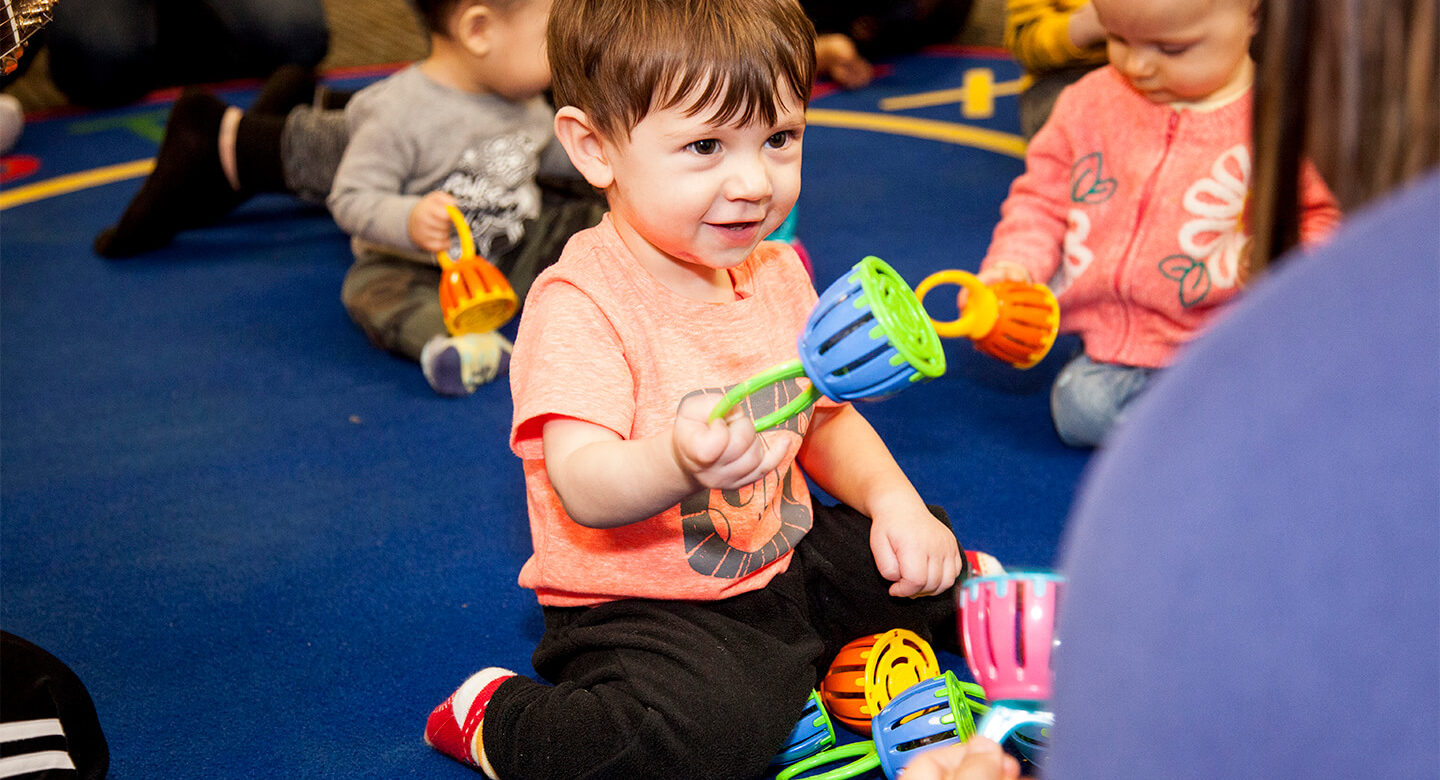
| Rockin’ Railroad: Unplugged (5 months to 5 years) | “Movement songs, lap activities, shared musical story time, group drumming exploration, and bubbles galore,” with a different instrument and musical genre each week | Attention to speech, imitating gestures and sounds, banging objects together |
Source: Kidville Upper West Side class schedule and class descriptions, verified November 6, 2026
Classes are booked through a membership: Single Class Membership is $219 a month for 4 classes plus 3 free playspace passes a month, and Double Class Membership is $399 a month for 8 classes plus unlimited playspace. For a closer look at each class, see our guides on baby gym classes, baby music classes and kids classes by age.
Possible downside: these are parent-and-child classes, so a grown-up comes to every session; they are not drop-off care. Big Muscles for Little Babies is listed for 8 to 15 months, so a child near 15 months will soon move up to Big Muscle Builders. When your child gets closer to 2 and is ready for short mornings apart, our guide on 2’s program vs preschool explains the next step at Kidville University.
What should a 1-year-old be learning: FAQ
What should we teach a 1 year old?
Teach through play: stacking and knocking down blocks, putting things in and out of containers, hiding a toy for them to find, turning pages, simple pegs, chunky-crayon scribbles, and naming everything you hand them. The AAP also suggests speaking slowly and clearly, using the correct names of objects and body parts, and letting your toddler copy everyday chores.
What are some developmental red flags for a 1-year-old?
The AAP’s health watch for 8 to 12 months: does not crawl, drags one side of the body while crawling for over a month, cannot stand when supported, does not search for objects hidden while they watch, says no single words such as “mama” or “dada,” does not use gestures like waving or shaking the head, and does not point to objects or pictures. Each is worth a call to your pediatrician.
What is considered advanced for a 1 year old?
The AAP does not define “advanced” at this age. It describes the usual range and says each baby “develops in his own manner.” A 1-year-old who walks early or says several words is doing something extra, which is a bonus rather than a benchmark, and a child who does these things a little later is usually not behind.
What should a 1 year old be able to do?
By 12 months, the AAP lists: pulls up to stand, walks holding on to furniture, may take two or three steps alone, uses a pincer grasp, puts objects into a container and takes them out, responds to simple requests and to “no,” says “dada” and “mama,” finds hidden objects, imitates gestures, finger-feeds, and helps when being dressed.
What skills should a 15 month old have?
The AAP pages used here describe 12 months and the second year rather than 15 months exactly. By then most toddlers are building on the 12-month list: steadier steps, easier pincer pickups, more words and gestures, and a big jump in understanding, since early in the second year a toddler “will suddenly seem to understand everything you say.” Ask your pediatrician about your child’s 15-month checkup.
How many words should my 15 month old be saying?
There is a wide normal range. At 12 months the AAP lists “mama” and “dada” and trying to imitate words, and it says most toddlers reach “at least fifty spoken words by the end of the second year.” The AAP also notes that some children talk less during the second year, so understanding and gestures matter as much as the word count.
The bottom line
A 1-year-old should be learning to stand and step, pick up small things, understand simple words, say “mama” and “dada,” find what is hidden and copy everything you do, all through play. The AAP’s list is a guide, not a test, and its red-flag list is short and specific. Talk to your toddler, name the world, and give them room to move. On the Upper West Side, Big Muscles for Little Babies, Big Muscle Builders and Rockin’ Railroad turn those milestones into 45 minutes of play with you right there.
Ready to try a class with your 1-year-old? See the class schedule at Kidville Upper West Side, 205 West 88th Street, New York, NY 10024, and book your free first visit. Call 212-362-7792 with questions.
ABOUT THE AUTHOR
The Kidville Upper West Side Team runs the Kidville location at 205 West 88th Street, New York, NY 10024, home to music, gym, art, dance and STEM classes, Kidville University, Camp Kidville, an indoor playspace, birthday parties and a kids salon for children from birth to age 6. Every age, price and schedule detail in our guides is checked against Kidville’s own published pages.
Sources
Every Kidville detail in this guide comes from Kidville Upper West Side’s own pages, checked on November 6, 2026. Developmental milestones and guidance come from HealthyChildren.org, the American Academy of Pediatrics’ parenting site.
Kidville Upper West Side: Current Class Schedule
Kidville Upper West Side: Membership
Kidville Upper West Side: Free Trial Class
Kidville Upper West Side: Kidville University (Preschool Alternative)
Kidville Upper West Side: Contact
HealthyChildren.org (American Academy of Pediatrics): Developmental Milestones: 12 Months
HealthyChildren.org (American Academy of Pediatrics): Language Development: 1 Year Olds
HealthyChildren.org (American Academy of Pediatrics): Social Development: 1 Year Olds
HealthyChildren.org (American Academy of Pediatrics): Hand and Finger Skills: 1 Year Olds