

Why Is Play Important for Toddlers? 10 Benefits
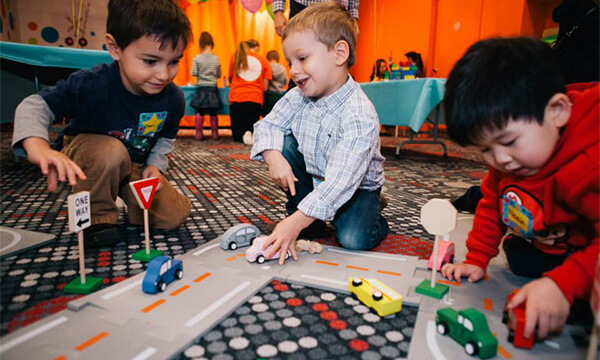
By the Kidville Upper West Side Team · Updated November 2026
SHORT ANSWER
Play is how toddlers learn. The American Academy of Pediatrics (AAP) calls play “serious business” for a child’s health and development, and says research shows it can improve children’s abilities to plan, organize, get along with others and regulate emotions, and helps with language, math and social skills and coping with stress. On the Upper West Side, the Kidville playspace and play-based classes give toddlers room to do all of it.
For a toddler, a cardboard box, a pot lid and a hallway are a full day’s work. It can look like “just playing,” and on a busy Upper West Side week it is easy to feel that play should wait until the lessons are done. The AAP says the opposite: play is the lesson. This guide covers why play is important for toddlers, the 10 benefits the AAP links to play, the four types of play and what each one teaches, simple ways to play at home with things you already own, and where toddlers can play on the Upper West Side when the apartment gets small. Every Kidville detail was checked on Kidville’s own pages on November 5, 2026.
Why is play important for toddlers?
Because play is how a toddler learns about the world, about other people and about their own feelings. The AAP’s Playing Is How Toddlers Learn page puts it simply: “Play is how your toddler explores and learns about the world as they grow and develop.” It adds that play is how young children start to get ready for school, because they learn “how to feel comfortable being with other children, and how to be a good friend,” and that “pretend play is one way children learn about difficult feelings like anger and fear.”
The AAP’s longer guide, The Power of Play: How Fun and Games Help Children Thrive, explains why pediatricians take it so seriously. “More than just a chance to have fun, play is serious business when it comes to a child’s health and development.” It also warns that play time has been shrinking for decades, and names the reasons: “tightly structured family and school schedules, fewer safe places to play and rising media use and screen time.” To push back, the AAP says pediatricians may begin writing a “prescription for play” at every well-child visit through age 2.
What are the 10 benefits of play?
The AAP links play to thinking skills, emotional control, language, early math, friendships, stress relief, movement, creativity and school readiness. Here are 10 benefits named in the AAP’s two play guides, with what each one looks like for a toddler.
| Benefit of play | What the AAP says | What it looks like for a toddler |
|---|---|---|
| 1. Planning and organizing | Research shows play can improve children’s abilities “to plan, organize” | Lining up cars before the “race,” deciding which block goes on top |
| 2. Getting along with others | Play improves the ability to “get along with others” | Handing a friend a shovel in the sandbox |
| 3. Managing emotions | Play improves the ability to “regulate emotions” | Waiting a turn on the slide without a meltdown, most of the time |
| 4. Language | Play “helps with language, math and social skills” | Naming every animal in the toy barn and making their sounds |
| 5. Early math | Play helps with math skills | Filling and emptying cups, stacking from big to small |
| 6. Coping with stress | In one study, 3- to 4-year-olds anxious about preschool were “two times more likely to feel less stressed when allowed to play for 15 minutes” | Calming down with a favorite game after a hard goodbye |
| 7. Movement and confidence | Physical play helps develop motor skills, and a playground slide lets a child “build confidence as they take risks in a relatively safe environment” | Climbing a soft ramp, then doing it again, faster |
| 8. Creativity and communication | Pretend play lets children “experiment with different social roles and learn to cooperate” | “You be the doctor, I’m the baby” |
| 9. Understanding feelings | “Pretend play is one way children learn about difficult feelings like anger and fear” | A stuffed bear who is scared of the dark, and a toddler who comforts it |
| 10. Getting ready for school | “Play gets children ready for learning,” including being comfortable away from parents and playing nicely with others | Joining a circle game with other children and a teacher |
Source: HealthyChildren.org, “The Power of Play: How Fun and Games Help Children Thrive” and “Playing Is How Toddlers Learn” (American Academy of Pediatrics), verified November 5, 2026

What are the types of play, and what does each one teach?
The AAP describes four kinds of play and says to “mix it up”: object play, physical play, outdoor play and pretend play. Each one builds something different, so a good toddler week includes some of each.
| Type of play (AAP) | What the AAP says it builds | Easy ways to do it on the Upper West Side |
|---|---|---|
| Object play (toys and things) | When playing with a toy, “babies become little scientists,” exploring by testing things, and older children learn symbolism, such as “using a banana as a telephone” | Blocks, containers and shape sorters at home; see our sensory play and STEM activities guides |
| Physical play | Develops motor skills, helps prevent childhood obesity and builds emotional intelligence; games like tag build social skills | Running and climbing in an indoor playspace or gym class; see our gross motor activities guide |
| Outdoor play | Lets children “use all their senses” to build spatial awareness and balance, and can improve attention span | Riverside Park and Central Park playgrounds on dry days |
| Pretend play | Children try out social roles, learn to cooperate, and build creativity, negotiation, communication and language skills | Dress-up, a toy kitchen, a stuffed animal “check-up” |
Source: HealthyChildren.org, “The Power of Play: How Fun and Games Help Children Thrive” (American Academy of Pediatrics), verified November 5, 2026
Music and movement count too. For the 1 to 3 age range, the AAP suggests singing songs, playing rhythms, encouraging “moving to the beat” and introducing simple games like Simon Says. Our music and movement activities for toddlers guide has easy ideas, and our fine motor activities guide covers the small-hand side of play.
How can I play with my toddler at home?
With simple things you already own, a few minutes of your full attention, and letting your toddler lead. The AAP’s ideas for ages 1 to 3 need almost nothing to buy. It recommends blocks, containers, spoons, shape sorters and puzzles, and adds that “it is parents and caregivers’ presence and attention that enriches children,” not “fancy electronic gadgets.”
| Try this | Why it works (AAP) | Apartment version |
|---|---|---|
| Let your toddler lead | “Playful learning, where children take the lead,” is what the AAP says to look for | Sit on the floor and follow their game for ten minutes |
| Describe what is happening | The AAP’s toddler tips: “Describe what’s going on to your child” | “What a long jump you made!” |
| Ask questions | Ask “What will happen next?” | Pause a story and let them guess |
| Pretend with everyday things | Encourage pretend play, “for example, pretending to drink out of an empty cup” | A tea party with plastic cups |
| Read, then act it out | Read regularly and encourage pretend play based on the stories | Be the three bears, with three different pillows |
| Move your body | Encourage walking, jumping and standing on one leg | Hallway hops and a pillow “river” to jump over |
| Sing and play rhythms | Sing songs, play rhythms, try Simon Says | Pots and wooden spoons as drums |
| Plan a playdate | The AAP says this is a good age for a parent-supervised playdate | One friend, one hour, a few toys to share |
Built on HealthyChildren.org, “The Power of Play” and “Playing Is How Toddlers Learn” (American Academy of Pediatrics), verified November 5, 2026
The AAP is also honest that this is tiring. “Playing with your child takes a lot of time and energy,” its toddler page says, and it suggests finding company for you and your child: library story hours, play groups, a popular playground “where you can meet other parents with young children,” and child care, which “provides an opportunity for your child to meet others.” For the Upper West Side version of that list, see our guide on where a toddler can socialize with other kids, and for indoor ideas when the weather turns, our rainy day activities for toddlers.
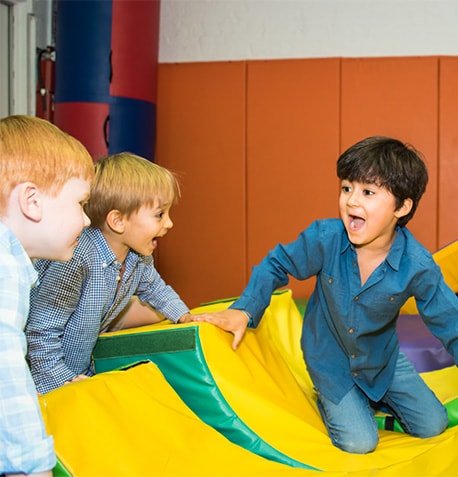
Where can toddlers play indoors on the Upper West Side?
At the Kidville playspace at 205 West 88th Street, where one of the gyms becomes an indoor playspace in 1-hour sessions Monday to Friday, plus play-based classes for babies and toddlers. The playspace page describes it as “a super fun and safe space to run, climb, and make new friends,” and the membership page describes “a modern, versatile space equipped with props to support gross/fine motor skills.” That covers physical play and social play in one hour, which is hard to do in an apartment in November.
| Option at Kidville Upper West Side | Details (from Kidville’s pages) | Type of play |
|---|---|---|
| Indoor playspace, single visit | 1-hour session, $31, 20% off siblings; register in advance | Physical and social play |
| Playspace packs | 5 for $150, 10 for $290, 20 for $560, 30 for $810; 10% off siblings on packs | Physical and social play |
| Weekday sessions | First sessions start at 9:00am Monday to Wednesday, 11:15am Thursday and 11:10am Friday; the last session ends at 5:20pm or 5:30pm | Fits around naps |
| Weekends | The weekend schedule is based on birthday parties; call for times | Check before you go |
| Single Class Membership | $219 a month: 4 classes a month plus 3 free playspace passes a month | Classes plus open play |
| Double Class Membership | $399 a month: 8 classes a month plus unlimited playspace | Classes plus open play |
Source: Kidville Upper West Side playspace and membership pages, verified November 5, 2026
For more structure, the current class schedule lists four play-based classes: Rockin’ Railroad: Unplugged (5 months to 5 years), Big Muscles for Little Babies (8 to 15 months), Big Muscle Builders (12 to 24 and 18 to 36 months) and My Big Messy Art Class (18 to 36 months and 2 to 4 years). Classes run 45 minutes, and the schedule page says your first visit is free. For 2-year-olds ready for a few mornings away from you, Kidville University builds the day around “play centers, rotating activities, and a familiar structured routine,” which matches the AAP’s advice to look for “quality child care or preschool programs that include playful approaches to learning.” Our guide on 2’s program vs preschool compares the options.
Possible downside: playspace sessions must be booked in advance, and weekend times depend on birthday parties, so a last-minute Saturday visit may not work. Check the playspace page for the current weekday times, or contact the front desk before you go.
Coming from Lincoln Square, Manhattan Valley or Morningside Heights?
The Kidville playspace is one ride on the 1 train from all three neighborhoods: get off at 86 St, at Broadway and West 86th Street. Families near Central Park West can also take the B or C to 86 St, which has an entrance at West 88th Street. Sessions, prices and packs are the same wherever you start.
| Coming from | Board at | Get off at |
|---|---|---|
| Lincoln Square | 66 St-Lincoln Center or 72 St (1 train) | 86 St, Broadway and West 86th Street |
| Manhattan Valley | 103 St or Cathedral Pkwy (110 St) (1 train) | 86 St, Broadway and West 86th Street |
| Morningside Heights | 116 St-Columbia University or Cathedral Pkwy (110 St) (1 train) | 86 St, Broadway and West 86th Street |
| Near Central Park West | B or C train (the B runs weekdays until 11 p.m.) | 86 St, Central Park West, with an entrance at West 88th Street |
Source: MTA 1 line and C line maps (station names, entrances and accessibility) and Kidville Upper West Side contact page, verified November 13, 2026
Bringing a stroller? The MTA 1 line map marks 96 St as ADA accessible, but it does not mark the 86 St stations on the 1 or on the B and C as accessible, so plan for stairs at 86 St. At Kidville, strollers stay at the stroller check on the main level. Because playspace sessions must be booked in advance, reserve a time on the playspace page that leaves room for the trip.
Why is play important for toddlers: FAQ
What are the benefits of play for a child?
The AAP says research shows play can improve children’s abilities to plan, organize, get along with others and regulate emotions, and that play helps with language, math and social skills and helps children cope with stress. Physical play builds motor skills and confidence, pretend play builds creativity and communication, and outdoor play builds balance and spatial awareness.
What are the 5 benefits of play?
Five benefits the AAP names directly: better thinking skills (planning and organizing), better social skills (getting along with others), better emotional control (regulating emotions), stronger language and early math, and lower stress. In one study the AAP cites, anxious 3- to 4-year-olds were twice as likely to feel less stressed after 15 minutes of play.
What are the 10 benefits of play?
From the AAP’s play guides: planning and organizing, getting along with others, managing emotions, language, early math, coping with stress, movement and confidence, creativity and communication through pretend play, understanding big feelings like anger and fear, and getting ready for school by feeling comfortable with other children and away from parents.
Why is it important to play with your toddler?
Because your attention is what makes play rich. The AAP says it is parents’ and caregivers’ “presence and attention that enriches children,” not electronic gadgets, and its toddler page suggests joining in, describing what your child is doing and asking “What will happen next?” Ten minutes of following your toddler’s game counts.
Why is free play important for toddlers?
Free play lets a toddler choose, test and invent, which is where planning, problem solving and creativity grow. The AAP advises looking for child care and preschools “that include unstructured playtime” and playful learning “where children take the lead,” and notes that tightly structured schedules are one reason children play less than they used to.
What is the role of play in early childhood education?
The AAP says “learning is best fueled by tapping into a child’s natural urge to play,” and advises parents to look for “quality child care or preschool programs that include playful approaches to learning.” In a play-based program like Kidville University, children learn through play centers, rotating activities and a familiar routine rather than worksheets.
Is there an indoor playspace near Lincoln Square, Manhattan Valley or Morningside Heights?
Yes. The Kidville Upper West Side playspace at 205 West 88th Street is one ride on the 1 train from all three neighborhoods: get off at 86 St, at Broadway and West 86th Street. Families in Lincoln Square can board at 66 St-Lincoln Center or 72 St, and families in Manhattan Valley and Morningside Heights at 103 St, Cathedral Pkwy (110 St) or 116 St-Columbia University. Each session runs 1 hour for $31, and you register in advance.
The bottom line
Play is not a break from learning for a toddler; it is how learning happens. The AAP links play to planning, emotional control, language, early math, friendships, stress relief, movement, creativity and school readiness, and says a parent’s attention matters more than any gadget. Mix object, physical, outdoor and pretend play through the week, let your toddler lead, and when the apartment feels small, the Kidville playspace on West 88th Street offers 1-hour sessions to run, climb and make new friends.
Need room to play this week? Book a playspace session at Kidville Upper West Side, 205 West 88th Street, New York, NY 10024, or try a class with a free first visit. Call 212-362-7792 with questions.
ABOUT THE AUTHOR
The Kidville Upper West Side Team runs the Kidville location at 205 West 88th Street, New York, NY 10024, home to music, gym, art, dance and STEM classes, Kidville University, Camp Kidville, an indoor playspace, birthday parties and a kids salon for children from birth to age 6. Every age, price and schedule detail in our guides is checked against Kidville’s own published pages.
Sources
Every Kidville detail in this guide comes from Kidville Upper West Side’s own pages, checked on November 5, 2026. Play guidance comes from HealthyChildren.org, the American Academy of Pediatrics’ parenting site.
Kidville Upper West Side: Playspace and Holiday Schedule
Kidville Upper West Side: Membership
Kidville Upper West Side: Current Class Schedule
Kidville Upper West Side: Free Trial Class
Kidville Upper West Side: Kidville University (Preschool Alternative)
Kidville Upper West Side: Contact
HealthyChildren.org (American Academy of Pediatrics): Playing Is How Toddlers Learn