
2’s Program vs Preschool: What’s the Difference?
By the Kidville Upper West Side Team · Updated November 2026
SHORT ANSWER
A 2’s program is a short school morning built for 2-year-olds, with a gradual separation from the parent, while preschool usually means a longer drop-off program for 3s and up. The AAP notes that center-based care goes by many names, including preschool and nursery school, so the label matters less than the hours, the separation and the ratio. On the Upper West Side, KVU 2s runs 120 minutes a day, 2 or 3 days a week, with a 1:4 ratio.
Two-year-olds on the Upper West Side get a lot of labels. A friend’s child goes to “the 2s,” another goes to “nursery,” a third is in “daycare,” and someone at the playground is already talking about 3-K. They can sound like the same thing with different names, and in one sense they are. This guide sorts them out: what actually changes between a 2’s program and a preschool, what the American Academy of Pediatrics (AAP) says about preschool, nursery and daycare, the ratios the AAP recommends by age, the questions to ask on a tour, and how the KVU 2s program at Kidville University works. Every Kidville detail was checked on Kidville’s own pages on November 4, 2026.
What is the difference between a 2’s program and preschool?
Mainly age, length of day, how separation is handled and how many children each teacher looks after. A 2’s program is designed for a child’s first time away from a parent, so the day is short and the separation is gradual. A preschool or 3s program is longer and assumes the child is ready for a full drop-off. The table compares the two steps at Kidville University with the city’s free 3-K program, so every line comes from a published page.
| What to compare | 2’s program (KVU 2s at Kidville) | 3s and preschool (KVU Grad, NYC 3-K) |
|---|---|---|
| Who it is for | 2-year-olds; Kidville calls it a “social pre-school alternative program” | KVU Grad is the 3s program; NYC 3-K is for the year a child turns 3 |
| Length of day | 120 minutes per day | KVU Grad: 180 minutes per day; NYC 3-K: full-day |
| Days per week | 2 or 3 days per week | KVU Grad: 2 or 3 days per week |
| Separation | Gradual and individualized; “teachers serve as guides for parents and children” | KVU Grad is a drop-off program for the whole morning |
| Teacher ratio | 1:4 teacher to child | KVU Grad: 1:4; the AAP standard for 3-year-olds is 7:1 |
| Cost | Tuition-based; current sessions and prices are on the KVU 2s page | KVU Grad is tuition-based; NYC 3-K is free |
| Getting in | No application; a tour is recommended | KVU Grad: no application; NYC 3-K: apply through NYC Public Schools |
| Potty training | Not needed; teachers are “trained and prepared to change diapers” | Not needed at Kidville University |
Sources: Kidville Upper West Side Kidville University, KVU 2s and KVU Grad pages; NYC Public Schools 3-K page; HealthyChildren.org, “Choosing a Child Care Center” (American Academy of Pediatrics), verified November 4, 2026
One more step sits before the 2s. KVU Prep is the pre-2s program: 90 minutes, one day a week, with a parent or caregiver in the room, so a child gets used to a classroom before any separation starts. If your child is not ready for any drop-off yet, our guide to mommy and me classes on the Upper West Side covers the parent-and-child options.
Are toddler programs and preschool the same?
In name, often yes. In practice, the difference is the age group, and the AAP’s ratios change a lot between 2 and 3. The AAP’s Choosing a Child Care Center page says center-based care “has many names,” including “child care center, preschool, nursery school, child development program, or learning center.” What does change with age is how many children one adult should look after. The AAP’s recommended maximums:
| Age | AAP maximum child-staff ratio | AAP maximum group size | What it means in a room |
|---|---|---|---|
| 12 months | 3:1 | 6 | One adult for every three babies |
| 13 to 35 months (includes 2-year-olds) | 4:1 | 8 | A room of 5 to 8 two-year-olds needs 2 trained caregivers |
| 3-year-olds | 7:1 | 14 | One adult can look after up to seven 3-year-olds |
| 4-year-olds | 8:1 | 16 | Groups get bigger as children get more independent |
Source: HealthyChildren.org, “Choosing a Child Care Center” (American Academy of Pediatrics), verified November 4, 2026
That is the clearest practical line between a toddler program and preschool: a 2-year-old needs almost twice the adult attention of a 3-year-old. Kidville University keeps a 1:4 teacher-to-child ratio, which the Kidville University page says “ensures little ones benefit from individualized attention during the separation process and beyond.” The AAP’s Why Quality Matters in Early Child Care page explains why this matters: “Children receive more individual attention and nurturing when they are in smaller groups and when each caregiver is responsible for fewer children.”

What are the key differences between daycare and preschool?
The AAP does not split them into two categories; it sorts care by where it happens and who provides it, and says quality matters more than the type. In everyday use, parents tend to say “daycare” for care that covers working hours and “preschool” for a shorter, school-style program. The AAP’s Making Child Care Choices Count for Your Family page describes three basic types instead:
| Type of care (AAP) | How the AAP describes it | Where a 2’s program fits |
|---|---|---|
| In-home care | A caregiver looks after your child in your own home; benefits include individual attention and “limited exposure to seasonal ailments such as colds and the flu” | A 2’s program covers a few mornings a week; the rest of the week is up to each family |
| Family child care | “Child caregivers provide their service out of their own homes” | A different setting from a classroom program |
| Center-based care | “Child care organizations feature structured activities and programs, as well as a trained staff” | A 2’s program like KVU 2s is center-based, in a classroom with a set routine |
Source: HealthyChildren.org, “Making Child Care Choices Count for Your Family” (American Academy of Pediatrics), verified November 4, 2026
The AAP’s quality page puts the bottom line plainly: for healthy brain development, “the type of child care arrangement is less important than the quality of care a child receives.” It also says young children, especially infants and toddlers, “need stable, positive relationships with their caregivers to thrive.” So whatever a program calls itself, the AAP’s questions are the ones to bring on a tour:
| Ask about | The AAP’s question | How KVU 2s answers it |
|---|---|---|
| Hours | What are the hours? How are vacations and holidays scheduled? | 120 minutes per day, 2 or 3 days per week; closures follow Kidville’s holiday schedule |
| Fees | What is the cost? How are payments made? | Current sessions and tuition are posted on the KVU 2s page |
| Ratios and group size | Do ratios and group sizes fall within nationally recognized standards? | 1:4 teacher-to-child ratio |
| Staff | What education, training and experience do the caregivers have? Are they certified in CPR? | Ask on your tour; the AAP also suggests asking how long staff have worked there |
| Communication | How often does the provider give feedback about your child? | Newsletters, progress reports and a private photo-sharing app |
| Visiting | Can you visit before enrolling? | Kidville recommends scheduling a tour before you enroll |
Built on HealthyChildren.org, “Choosing a Child Care Center” and “Why Quality Matters in Early Child Care” (American Academy of Pediatrics), and the Kidville University and KVU 2s pages, verified November 4, 2026
What happens in a 2’s program morning?
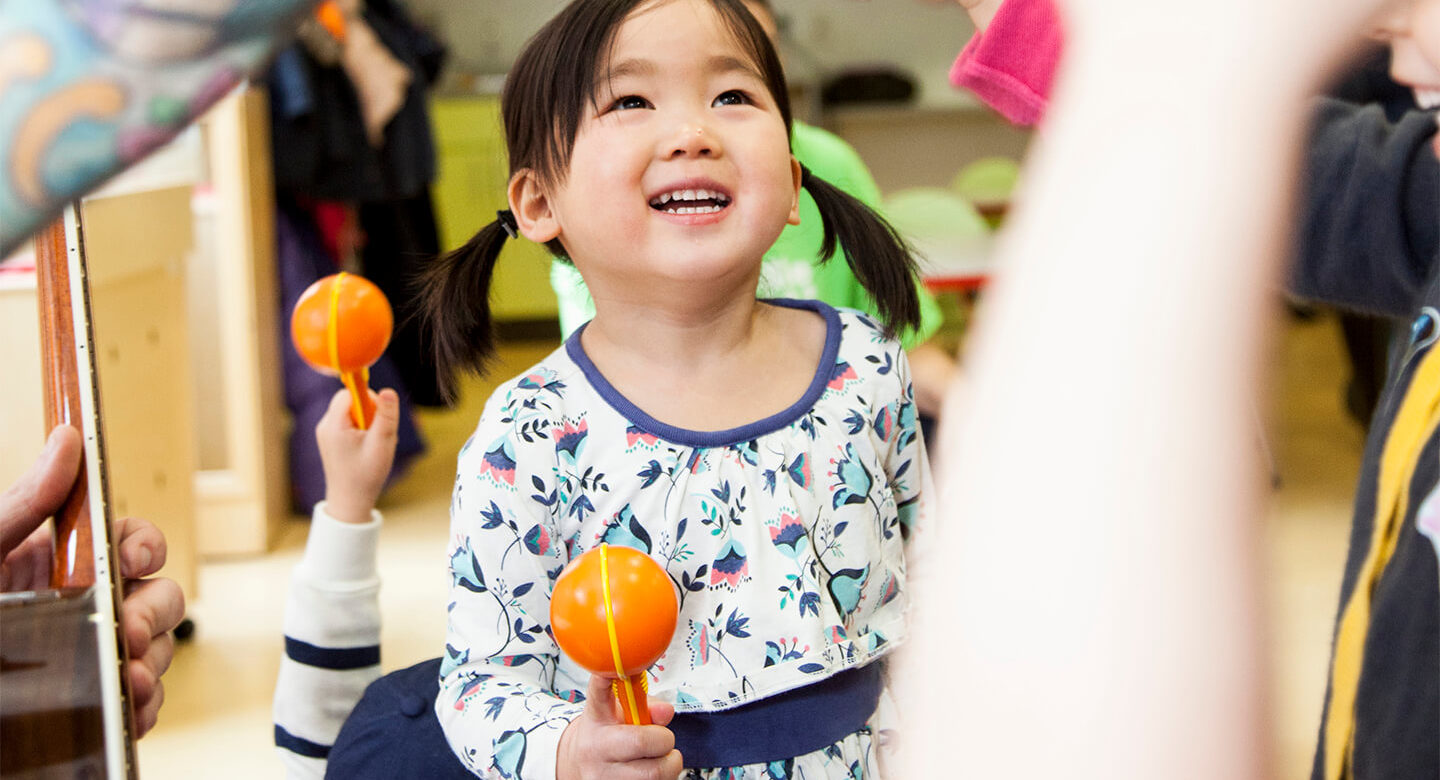
A short, predictable routine: a welcome, circle time, art and STEM, play centers, snack and gym, all in two hours. The KVU 2s page describes the program as “120 minutes per day. 2 or 3 days per week. Gradual separation.” and lays out the day below. The main Kidville University page adds an emergent curriculum, built around “the kids’ curiosities,” and a consistent routine so that children and their grown-ups “know what to expect.”
| Part of the KVU 2s morning | What happens (from the Kidville page) | What it practices |
|---|---|---|
| Welcome time | “An inviting environment (think: digging bins) welcomes kids” as they say “see ya later” to grown-ups once separated | Separating with a calm, familiar start |
| Circle time | An interactive hello song, then story time, music and movement, or dramatic play introduces the weekly theme | Listening in a group, language, songs |
| Art and STEM | “open-ended art and exploration as kids investigate and manipulate a myriad of tactile materials” | Hand skills, curiosity, early science |
| Class centers | Children “move freely between designated areas for dramatic play, reading, puzzles, and other manipulatives” | Choosing, pretend play, playing near and with friends |
| Snack time | A light snack during community time “allows for socializing, practicing manners” | Sitting together, manners, conversation |
| Gym | Time in the gym to move and use up extra energy | Running, climbing and taking turns |
Source: Kidville Upper West Side KVU 2s and Kidville University pages, verified November 4, 2026
For a deeper look at the skills behind each block, see our guide on what a 2-year-old should be learning, which maps the AAP’s milestones for age 2 onto a 2’s program day. When your child turns 3, the next step and its daily schedule are covered in what a 3-year-old should be learning.

Is a 2’s program or preschool the right fit for my child?
It depends on your child’s age and how ready they are to separate, not on the label. The table matches common situations with the program built for them. Kidville University runs all three steps at 205 West 88th Street, so a child can move from one to the next without changing schools.
| If your child | A good fit | Why |
|---|---|---|
| Is under 2 or has never been apart from you | KVU Prep (pre-2s) | 90 minutes, one day a week, with a parent or caregiver in the classroom |
| Is 2 and ready to try short mornings apart | KVU 2s | 120 minutes, 2 or 3 days a week, gradual and individualized separation, 1:4 ratio |
| Is 3 and already separates well | KVU Grad (3s) | 180 minutes, 2 or 3 days a week, drop-off |
| Turns 3 next year and needs full-day care | NYC 3-K | Free, full-day, apply the year your child turns 3 |
| Still cries hard at every goodbye | Start with Prep or a parent-and-child class | Kidville describes Prep as a pre-separation program where independence is gained gradually |
Sources: Kidville Upper West Side KVU Prep, KVU 2s and KVU Grad pages; NYC Public Schools 3-K page; HealthyChildren.org (American Academy of Pediatrics), verified November 4, 2026
If you are still deciding whether your child is ready at all, our guide on how to prepare a toddler for preschool walks through the readiness signs, and toddler separation anxiety at daycare explains what normal goodbyes look like in the first weeks. For the full Kidville University lineup, see our preschool alternative guide.
Possible downside: a 2’s program is short by design, so two hours a few mornings a week does not replace care for a full working day. Kidville’s FAQ also says it “typically only” accepts new students “at the start of the Fall and Winter sessions,” so check the KVU 2s page for current start dates, and request a tour to see a morning in progress.
2’s program vs preschool: FAQ
Are toddler and preschool the same?
Often the names overlap. The AAP says center-based care “has many names,” including preschool and nursery school. What changes is the age group: the AAP recommends no more than 4 children per adult for 13 to 35 months and up to 7 per adult for 3-year-olds, so a toddler program has smaller groups, shorter days and a gentler separation than a 3s preschool.
What is better, preschool or nursery?
Neither name is better on its own. The AAP lists preschool and nursery school as names for the same kind of center-based care, and says “the type of child care arrangement is less important than the quality of care a child receives.” Compare the ratio, group size, staff training, communication and how separation is handled, and visit before you enroll.
What are the key differences between daycare and preschool?
Parents usually use “daycare” for care that covers working hours and “preschool” for a shorter, school-style program, but the AAP sorts care by setting: in-home care, family child care and center-based care with “structured activities and programs, as well as a trained staff.” A 2’s program like KVU 2s is center-based, with a 120-minute morning rather than a full working day.
Does my 2 year old need to go to school?
No. A 2’s program is a choice, not a requirement. NYC’s free public early education starts with 3-K, which families apply for the year their child turns 3. A 2’s program is for families who want a first, gentle school experience before then, with short mornings and a gradual separation.
Is there free preschool for 2-year-olds in New York City?
NYC Public Schools’ free, full-day 3-K program is for the year a child turns 3, so a younger 2-year-old is not yet in that age group. KVU 2s at Kidville Upper West Side is a tuition-based program; its current sessions and prices are posted on the KVU 2s page.
What are the downsides of preschool?
Separation takes time, and some children need a few weeks to settle at drop-off. Group settings also mean more exposure to everyday illness; the AAP lists “limited exposure to seasonal ailments such as colds and the flu” as an advantage of in-home care. Programs run on a set schedule, and a short 2’s morning does not cover a full working day. A gradual separation helps with the first.
The bottom line
A 2’s program and a preschool are steps on the same path: the 2’s program is shorter, smaller and built around a first separation, and preschool is the longer drop-off day that follows. The AAP says the name matters less than the quality, and its ratio chart shows why a toddler room needs more adults than a 3s room. On the Upper West Side, KVU 2s offers 120-minute mornings, 2 or 3 days a week, with a gradual separation and a 1:4 ratio, leading into the KVU Grad 3s program.
Want to see a 2’s morning? See the KVU 2s program at Kidville Upper West Side, 205 West 88th Street, New York, NY 10024, and request a tour. Call 212-362-7792 with questions.
ABOUT THE AUTHOR
The Kidville Upper West Side Team runs the Kidville location at 205 West 88th Street, New York, NY 10024, home to music, gym, art, dance and STEM classes, Kidville University, Camp Kidville, an indoor playspace, birthday parties and a kids salon for children from birth to age 6. Every age, price and schedule detail in our guides is checked against Kidville’s own published pages.
Sources
Every Kidville program detail in this guide comes from Kidville Upper West Side’s own pages, checked on November 4, 2026. Child care guidance comes from HealthyChildren.org, the American Academy of Pediatrics’ parenting site, and 3-K details come from NYC Public Schools.
Kidville Upper West Side: KVU (2s Program)
Kidville Upper West Side: Kidville University (Preschool Alternative)
Kidville Upper West Side: KVU Prep (Pre-2s Program)
Kidville Upper West Side: KVU Grad (3s Program)
Kidville Upper West Side: Contact
HealthyChildren.org (American Academy of Pediatrics): Choosing a Child Care Center